On this page
Why Do UTV Belts Keep Breaking? (And How to Finally Stop It)
If you've gone through two, three, or even four belts in a single season, you already know the frustration. You can swap a belt on the trail, but it costs you time, money, and momentum. The problem is that most riders keep replacing the belt without ever fixing what's actually killing it.
The belt is rarely the problem. The clutch is.

Why Do UTV Belts Keep Breaking?
The most common reasons UTV belts keep breaking are:
-
Improper clutch calibration
-
Secondary clutch misalignment
-
Worn clutch sheaves
-
Improper clutch cooldown procedures
All four issues cause excessive heat and belt slip, which dramatically shorten the CVT belt's life.

Four Most Common Reasons UTV Belts Fail
Here's a breakdown of the four most common reasons UTV belts fail — and what you can do to stop it from happening again.
1. Miscalibrated Clutch — Your Belt Is Working Harder Than It Should
Your CVT clutch system has one job: to transfer power from your engine to your wheels as efficiently as possible. When the clutch is properly calibrated for your specific machine — your tire size, your tune, your riding terrain — it does that job with minimal belt stress.
When the calibration is off, the belt is constantly fighting to make up the difference. Engagement happens at the wrong RPM. The clutch doesn't shift out cleanly. The belt slips under load. And belt slip generates heat, which is the number one killer of CVT belts.
Think of it like a 10-speed bike. If you're in the wrong gear for the terrain, you're working twice as hard to go half as fast. Your clutch works the same way. Wrong calibration means wasted energy — and your belt pays the price.
This is why tire upgrades and engine tunes require a clutch recalibration. Adding 35-inch tires on a clutch calibrated for 30s will throw off your shift RPM and force your belt into a constant state of slip. Adding a tune without adjusting your clutch means the extra power never fully makes it to the wheels — and the belt absorbs the difference.
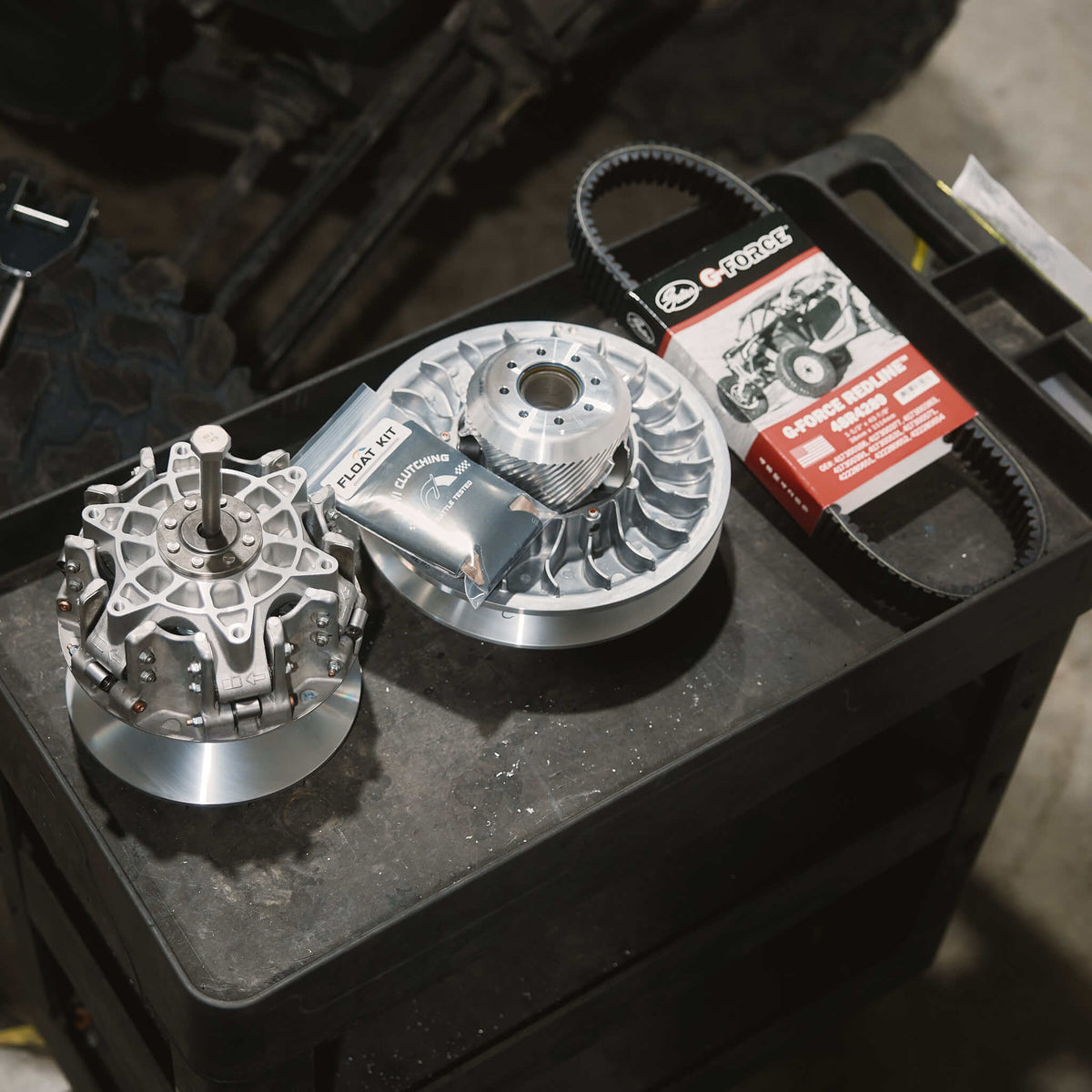
A properly calibrated KWI clutch kit dials in your engagement and shift RPM to match your exact setup. The result is cleaner power delivery, less belt stress, and significantly longer belt life.
2. Secondary Clutch Misalignment — A Factory Problem That Destroys Belts
On most Can-Am X3 machines — and many other UTVs — the secondary clutch is fixed in a static position from the factory. This sounds fine in theory, but in practice, it creates a serious alignment problem. Find our Can-Am Belt collection.
If the secondary is even slightly out of position (and on most machines, it is), the belt doesn't run straight between the primary and secondary. Instead, it runs at an angle, which causes the belt to twist under load. That twist creates uneven contact with the sheave faces, uneven wear across the belt width, and a massive buildup of heat — especially at higher speeds.
The misalignment issue is compounded by another factory problem: at idle, a misaligned secondary can cause the belt to contact one of the primary sheave faces, which keeps the secondary spinning. You'll notice this as difficulty shifting between Park, Reverse, Low, and Drive. If you're forcing those shifts, you're fighting a moving drivetrain — and potentially damaging your shift forks.
The KWI Full Float Mod modifies the secondary clutch to float freely and self-align with the primary at all RPMs. This eliminates the belt twist, corrects the alignment, and removes the root cause of one of the most common belt failure patterns we see come through our shop. The KWI Fusion Secondary — available for the Kawasaki Teryx H2, Polaris RZR Pro R, and Speed UTV — works on the same principle: a floating secondary that keeps the belt in alignment at all times, eliminating the same issues that plague fixed-secondary machines regardless of platform.

3. Worn Sheave Faces — When Your Clutch Can't Grip the Belt
Your clutch sheaves are the cone-shaped surfaces that clamp down on the belt to drive it. Over time — especially without regular service — those surfaces wear down and develop grooves from constant belt contact KWI Technical Support.
When the sheaves are worn, they can no longer grip the belt effectively. Instead of clamping cleanly and transferring power, the sheaves allow the belt to slip. That slip generates friction. That friction generates heat. And sustained heat destroys the belt's rubber compound from the inside out.
Sheave wear is a gradual process, which is why many riders don't notice it until belts start failing much more frequently than they used to. By then, the sheaves have been worn for a long time, and the damage is significant.
The fix is sheave machining — a service KWI performs as part of every Float Mod and as a standalone Sheave Machining service. Machining removes a thin, precise layer of material from each sheave face to eliminate the grooves, restore the correct surface angle, and give the belt a clean, even surface to grip. A freshly machined sheave grabs the belt the way it's supposed to — no slip, no excess heat, no premature belt failure.
Sheaves are a wearable item, just like brake pads. Regular inspection and periodic machining are part of keeping your clutch system performing correctly.
4. Improper Cooldown — The Habit That's Killing Your Belts
This one surprises a lot of riders. After a hard run — especially in dunes, mud, or on a steep climb — the instinct is to pull up, shut it down, and walk away. Or to sit and idle while you take a break.
Both of those habits are actively damaging your belt and your clutch.
Here's what's happening: during a hard ride, your clutch system generates significant heat. That heat is managed by airflow through the clutch housing — air that's generated by the clutch spinning at speed. When you stop suddenly or drop to idle, that airflow stops. The heat has nowhere to go, so it concentrates in one spot — right where the belt contacts the sheaves.
The result is a localized hotspot that degrades the belt's rubber compound, causes glazing on the sheave face, and dramatically shortens the life of both the belt and the clutch components.
The correct cooldown procedure: after any hard riding, drive at 4,000–5,000 RPM for at least two full minutes before stopping. That RPM range generates enough airflow through the housing to bring temperatures down properly before you shut off.
Two minutes. That's all it takes. It's the single easiest thing you can do to extend belt life, and most riders have never been told to do it.

The Real Solution: Fix the Clutch, Not Just the Belt
Most UTV owners cycle through belts season after season without addressing the root cause. They buy a better belt, run it until it fails, and buy another one. It's an expensive loop that never ends.
The reason belts keep failing is almost always the clutch — miscalibrated, misaligned, worn, or improperly cooled. Fix those four things, and belt life improves dramatically. We consistently see customers go from 200–400 miles per belt to well over 1,000 miles after addressing the clutch system.
At KWI, we've spent years engineering solutions specifically for these problems:
Calibrate your clutch to your exact setup: tire size, tune, weight, and terrain. Available for Can-Am QRS and PDrive, Polaris RZR, and Kawasaki platforms.
-
KWI Float Mod
Corrects factory misalignment, machines the sheave faces, and floats the secondary to self-align with the primary. The most comprehensive solution for Can-Am X3 clutch issues.
A complete billet clutch replacement for the Kawasaki Teryx H2. The Fusion H2 eliminates belt overheating with a floating secondary design and delivers nearly infinite calibration adjustability for any tire size, terrain, or elevation.
-
KWI Fusion Pro R System
A full billet clutch system engineered for the Polaris RZR Pro R. The Fusion Pro R features the same floating secondary technology and precision-machined primary as the Fusion H2, purpose-built for the Pro R platform to handle all power levels, large tires, and demanding terrain without the belt failures that plague the stock clutch setup.

Stop Replacing Belts and Fix the Real Problem
If your UTV belt keeps breaking, replacing the belt alone rarely solves the issue. Most failures stem from clutch calibration issues, alignment problems, worn sheaves, or excessive heat buildup.
At KWI Clutching, we've engineered solutions specifically designed to eliminate these root causes and maximize belt life across Can-Am, Polaris, Kawasaki, and Speed UTV platforms.
Whether you need a clutch kit, Float Mod, Fusion System, or technical guidance, our team can help diagnose the problem and recommend the right solution. Reach out to our support team at support@kwiclutching.com. Shop Clutch Kits, Float Mod packages, and Fusion Systems at kwiclutching.com.
Explore KWI Clutching products or contact our support team for expert assistance.