On this page
The Can-Am Maverick X3 is an incredible off-road machine. Ripping through the desert, climbing rock faces in Moab, running the trails at Hatfield-McCoy, or dropping into the big bowls at Glamis — this thing is a blast almost everywhere you point it. Check out - Glamis UTV Clutch Upgrades for 2026
But if you have owned one for any length of time, you have probably run into at least one of these: the machine fights you when you try to shift between drive modes, the secondary clutch spins at idle like the machine wants to move, or you keep going through belts faster than you should. Those three complaints show up constantly in owner groups, and most people treat them as three separate problems.
They usually are not. In most cases, they trace back to the same factory issue, and once you understand what is happening, it is a straightforward thing to correct.

First, About the CVT
There is a persistent argument online that the CVT is the weak point of these machines and that a conventional transmission would be better. We disagree, and we have spent years inside these clutch systems building the case. A properly set up CVT keeps the engine in its power band, delivers power smoothly, and gives you tuning flexibility a fixed-gear transmission simply cannot match.
The reason CVTs have picked up a bad reputation is that the factory systems ship with real, identifiable flaws. Fix those flaws and the complaints go away. The clutch design is not the problem — the tolerances are.
How the X3 CVT Actually Works
Quick refresher, because the failure makes more sense once the mechanics are clear.
As engine RPM climbs, the flyweights in the primary clutch swing outward and push the movable sheave in toward the fixed sheave. That squeezes the belt and forces it to ride higher up the primary. The belt then drives the secondary clutch, which sends power through the gearbox to the wheels. The faster you go, the tighter the primary closes on the belt and the higher the belt climbs.
The important detail: in each clutch, one sheave is fixed and one moves. So every time the primary shifts, the belt does not just climb — it also moves sideways.

Why Is My Can-Am X3 Hard to Shift?
On 2017 through current X3 models, we consistently find a slight misalignment in the secondary clutch from the factory. The belt does not sit centered where it should. Instead, it rides unevenly, favoring two of the four sheave faces rather than loading all four the way the design intends.
That single condition produces all three of the symptoms riders complain about.
Why Does the X3 Secondary Clutch Spin at Idle?
When the belt is not centered, it drags against a primary sheave even at idle. That contact is enough to turn the secondary. With the secondary turning, the shift forks are spinning as though the machine is already rolling — which is exactly why the machine fights you when you try to change drive modes.
This is where real damage gets done. Riders who do not know what is happening force the shifter, and forcing a gear against a spinning shift fork is how you turn an alignment issue into a gearbox repair.
Can Clutch Misalignment Cause X3 Belt Failure?
Because the secondary is fixed in position from the factory, the belt gets pulled toward the motor and twisted as the primary shifts. A twisted belt is a stressed belt, and that stress shows up as heat. Heat is what kills belts. So you get premature failures that feel random but are not — the belt was being cooked by geometry the entire time.
There is a power cost too. Energy the engine spends fighting a misaligned, twisted belt is energy that never reaches the wheels. A clutch system that spins freely and cleanly puts more of the motor's output on the ground.
Why Your Sheaves Wear Unevenly
When the belt is pulled off-axis, it presses harder on the primary outer sheave and the secondary inner sheave than on the other two faces. Those two wear faster than the rest. As that uneven wear accumulates, engagement gets less consistent, performance falls off, and belt life gets worse — the problem compounds on itself the longer it goes uncorrected.

If It Happens to You on the Trail
Do not force it. Shut the machine off, change drive modes with the engine off, then restart. That gets you moving again without putting a spinning shift fork into a gear it does not want to enter. It is a workaround, not a fix, but it will keep a bad day from becoming an expensive one.
The KWI Float Mod: Correcting Secondary Alignment
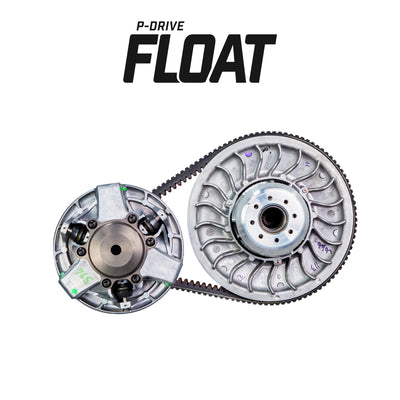
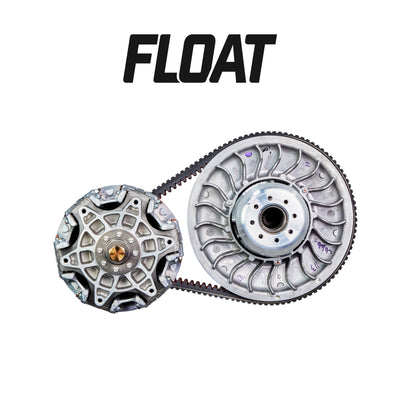
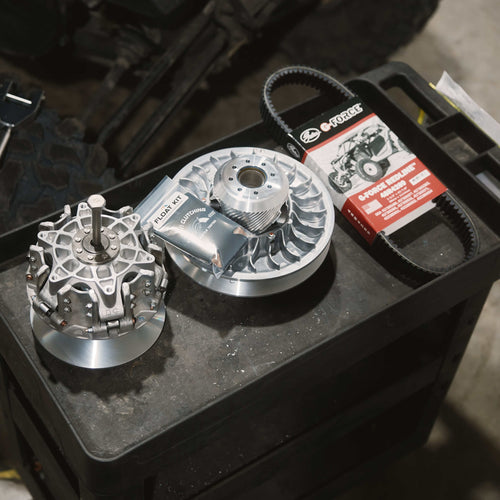
The KWI Float Mod machines the secondary so it floats on the shaft, letting it self-align with the primary throughout the entire shift range. The belt stays in line instead of being dragged sideways and twisted. That one change addresses the whole chain of symptoms: the secondary stops spinning at idle, shifting between drive modes gets easy again, belt stress and belt heat come down, sheave wear evens out, and the clutches spin more freely so more power reaches the wheels.
Every Float package also starts with a full inspection of both clutches. Sheaves are resurfaced and trued to machine out uneven spots and factory casting inconsistencies, so you are starting from a known-good baseline rather than modifying worn parts. If we find something worn or damaged during inspection, you get an estimate for approval before any further work happens.
The Float Mod also replaces the OEM secondary rollers, which are a known sore spot on this system, with KWI lifetime warranty rollers that last longer and perform better.

PDrive X3 Owners Have Additional Issues to Consider
When Can-Am introduced the PDrive, expectations were high. In practice, it brought its own set of problems on top of the alignment issue, and PDrive owners often deal with two failure modes at once.
PDrive Primary Internals Can Swell
After the clutches heat up, internal components in the PDrive primary swell. Once that happens, the primary can stay engaged on the belt instead of fully releasing at idle — which produces the same spinning secondary and hard shifting symptoms as a misalignment. Some owners have resorted to physically striking the clutch to get it to release. KWI put extensive R&D into this, and every PDrive Float now includes the PD Update: in-house designed internals that do not swell and keep the clutch from sticking.
PDrive Primary Roller Wear
PDrive primary rollers wear quickly. As they get sloppy, the governor cup is allowed to shift, the outer half and governor cup can catch on each other, and the clutch stops opening the way it should — more hard shifting.
Nearly every PDrive primary that comes through our shop has rollers that need replacing, so every PDrive Float Mod includes a fresh set of BRP rollers. Be aware that because of how the clutch is designed, there is no permanent fix here — rollers are a wearable item and will need replacement periodically. How and where you ride determines how long they last. Inspect them regularly: a healthy roller should roll and slide side to side, but it should not wiggle or feel sloppy on the roller pin. Once you feel that play, it is time for new ones.

Choosing Your Float Package - Which X3 Float Mod Is Right for You?
We offer the Float Mod in four packages for both QRS and PDrive systems, so you can start where the problem is and build from there.
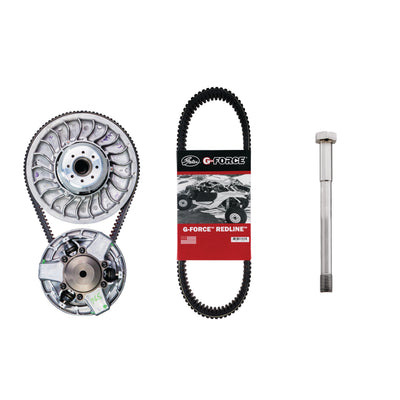
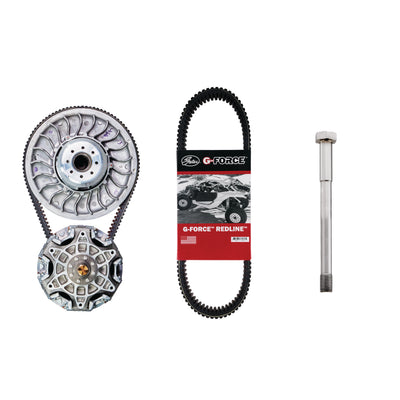
• Float Mod — Foundation-Level Reliability Upgrade: Sheave machining to correct uneven spots and inconsistencies, secondary float machining, and new lifetime-warranty secondary rollers. PDrive versions add the non-swelling primary internals and a new set of BRP primary rollers.
• Float Plus — Float Mod + Complete Clutch Kit: Adds a full KWI clutch kit. We calibrate the clutch to your riding terrain, tire size, engine power, and machine weight to maximize wheel horsepower. If you want performance gains alongside the reliability fix, this is where to start. It genuinely wakes the machine up.
• Float Pro — Float Plus + Groovix Helix: Adds a Groovix helix to the secondary. Better belt grab means less belt slip, and belt slip is a major heat source that leads to failures. You also get improved backshifting — how the machine responds when you come off the throttle — and better cooling, since the Groovix design pulls cooler air through the clutch. This is our number one selling package for both QRS and PDrive.
• Float Pro Aggressive — Maximum-Load Setup: Everything in the Pro, plus our blue/pink secondary spring for reduced belt slip under heavy load. If you ride dunes, mud, or rock crawl, this is the one you want.
The Bottom Line
Hard shifting, a secondary that spins at idle, and belts that keep letting go are not three unrelated problems, and they are not just something you have to live with. They are symptoms of a clutch system that is not aligned the way it needs to be, and on PDrive machines, of primary components that were not built for the heat they see.
Correct the alignment and the whole system settles down. You get smoother shifting, cooler and longer-lasting belts, more even wear, and better power delivery — plus peace of mind that the machine is going to behave when you are a long way from the trailer.
Have questions about which package fits how you ride? Reach out — we will walk you through it. Every Float Mod is machined in-house right here in the USA. See all Can-Am clutch mods.